
Garden City Resident Lookup Records
Treat a Garden City resident lookup as a series of narrow questions. It is not one broad hunt. The City of Garden City BS&A portal handles owner, address, and parcel searches. Michigan's voter system answers registration questions. A lawful Qualified Voter File request serves a defined scope, not a full household roster. MiCOURT surfaces public case information for participating courts. MDHHS holds event records under rules that differ sharply by type. Each yields a lead. Compare the leads by date and by some independent attribute before calling them one person.
| Record | What It Confirms | Where | Access |
|---|---|---|---|
| Assessment record | Owner of record, parcel, situs, possible mailing clue | Garden City BS&A | Public reference search; city counter or FOIA path if needed |
| Recorded land instrument | Party role, legal description, recorded transfer date | Wayne County Land Records | Free name index; expanded modes and images have paid or counter/mail routes |
| Voter registration | Registration-related residence evidence and status | Michigan Voter Information Center | Public records through FOIA, with statutory withholding |
| Court record | Party, case number, type, date, status, disposition | MiCOURT Case Search | Public display only; clerk holds the official file |
| Vital record | Recorded life event and eligible relationship information | MDHHS Vital Records | Eligibility, fees, and timing depend on the record |
Begin with the source that matches the fact you already hold. An address belongs with the assessor or the parcel layer. A dated court matter belongs with MiCOURT and then the court of record. A death, marriage, or divorce belongs with the vital-record custodian. Never blend these into a single claim. A court address, a directory entry, and an owner mailing address are not the same thing.
Verifying Garden City Resident Details
Before two matching names become one person, demand two independent attributes. A middle initial, a parcel number, a prior address, an approximate year, a relative named in an eligible record, or a dated case event will separate a true match from a common-name error. Search surname-first and given-name-first. Test initials too. Prior or married surnames, hyphenation, and alternate spellings in older material all deserve a turn. Try a parcel number or a dated case event. These details separate a true match from a common-name error.
- Record the full name variant, the Garden City address if known, and a date window.
- Search BS&A by name or address and retain the parcel, situs, and separate mailing field as distinct facts.
- Search MiCOURT with the name variants and birth year, then confirm that the court, date, and participant role fit the person.
- Use the Register of Deeds or an eligible vital-record channel only to test a specific dated link, then obtain an official copy from the custodian when one is required.
- Docket
- A court’s running record of a case, including filings and events. A public screen may show only part of it.
- Index versus image
- An index helps locate a record. An image is the underlying document and can have a different access route.
- Certified copy
- A copy issued and certified by the custodian. It has a different purpose from a search result or a historical index.
Note: Save the date and source URL with each result, because registration, recording, and filing dates can describe different moments.
MiCOURT Garden City Name Checks
The Garden City case-search instruction sends searchers to MiCOURT for 21st District Court matters. The portal serves a public name search well. It stays informational, though, and never replaces the official court record. Choose the court that fits the matter. A name result can be narrowed by first name, middle name, and birth year, since the public interface does not accept a full date of birth as its normal search control.
| MiCOURT field | How it helps |
|---|---|
| Last name or business | Required name-panel starting field. |
| First and middle name | Narrows a common surname. |
| Birth year | Provides a limited disambiguator without a full public birth date. |
| Case number year, number, and type | Moves from a known case to its participant list. |
| Filter or Show | Opens available narrowing controls; the portal may expose fewer controls than its underlying documentation. |
The MiCOURT public search appears below. Court coverage and public case categories vary, and confidential case types stay excluded.
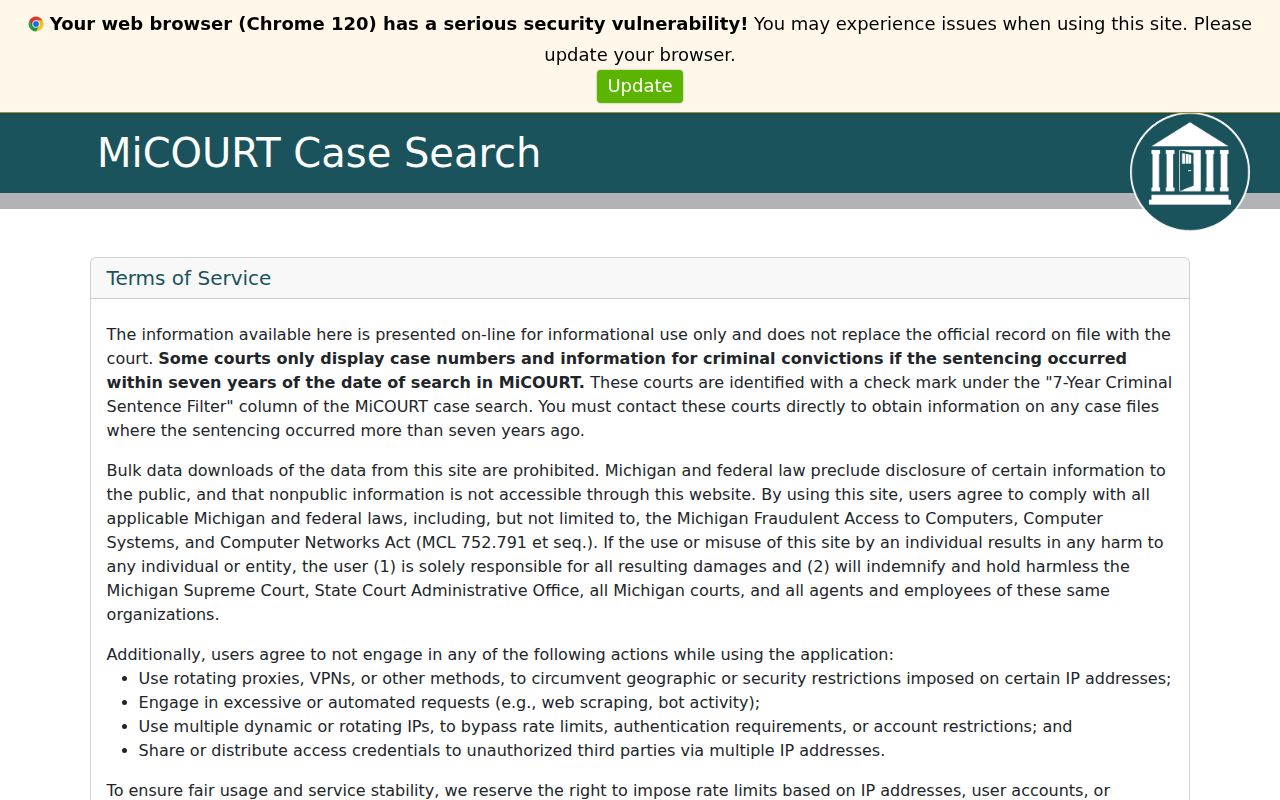
A result may list court location, case number, case type, filing date, status, disposition, participant role, judge, or agency fields where present. None of it replaces the court file itself. Some criminal displays remain limited by the portal's seven-year sentencing caveat.
Garden City Court Result Fields
Read each result as an inventory, not a biography. A public MiCOURT entry may show county and court location, original and current case numbers, filing or reopen dates, a closed date, status, disposition, judge, prosecutor or police agency where applicable, charges, and participant roles. The real question is whether several fields fit the person and the date you have. If the entry points to 21st District Court, turn to the court's local contact information for inspection, older material, copies, certification, or a correction. Court policy permits inspection of public information. Juvenile, adoption, name-change, mental-health, sealed, set-aside, and other protected matters stay outside a normal public search. Remember that a missing online result never proves no record exists.
Garden City Voter Record Limits
Michigan voter-registration records are public through FOIA, but their release carries firm limits. The state election guidance describes the Qualified Voter File structure. The personalized MVIC route covers an individual's own status. A lawful QVF request can be scoped to a city or township, district, ward, precinct, school, or village. It is not an advertised radius or street-by-street roster request.
Publicly releasable data may include a name, residential or mailing address, year of birth, registration date, status, voter ID, and participation history when legally available. Withheld fields include driver-license and state-ID numbers, month and day of birth, phone, email, digitized signature, and Social Security digits. Michigan registers no one by party. Participation history never reveals ballot choices. Treat status as a file state, not a promise. The person may not have stood in Garden City on the search date.
Michigan Vital Record Channels
Michigan vital records start in 1867 for births, deaths, and marriages. Divorce records begin later, in 1897. Each type of record has its own custodian and its own rules. Birth records under 100 years old stay restricted. Only the person named on the record may request one. A parent can request one too. So can a legal guardian, an eligible heir, a court, or a properly represented client. Once a birth record passes the 100-year mark, it opens up for genealogy research. Death, marriage, and divorce certificates can be requested in writing after the required search fee is paid. The custodian's rules govern each request.
MDHHS takes mail orders with a signed application and the required identification or proof. Its ordering information also lays out the authorized online provider, the phone route, a drop box, appointments, and will-call pickup. The Garden City Clerk posts local birth and death request forms. Marriage-license material for the county goes through the Wayne County Clerk. An index hit is only a lead. A certified copy always comes from the issuing custodian.
The Michigan birth application asks for the person on the record, event details, parent names, the applicant's relationship, a signature, and eligibility documents. Heirs must add a relationship statement and details about the deceased person. The search fee is due even when no record turns up. Those requirements explain why a resident lookup cannot promise an unrestricted current birth search. For older genealogy work, the 100-year rule changes the access channel. Still, an index hit never becomes a certified record on its own.
Garden City Lookup Safety Limits
Some records carry legal walls, and a responsible search stops at them. Garden City residents should know that Michigan's Address Confidentiality Program shields qualifying survivors. It provides a substitute address and mail forwarding. That shielded address stays outside routine FOIA disclosure. The same caution applies to sealed, juvenile, adoption, and confidential vital records. Cross-referencing them to expose a person is abuse of the residents directory, not research. If a listing looks wrong, route the error to the custodian or the program contact. Do not hunt for a protected location.
The Michigan Public Sex Offender Registry exists for one narrow purpose. It is a public-safety tool, not a general resident lookup or a full criminal-history source for Garden City.
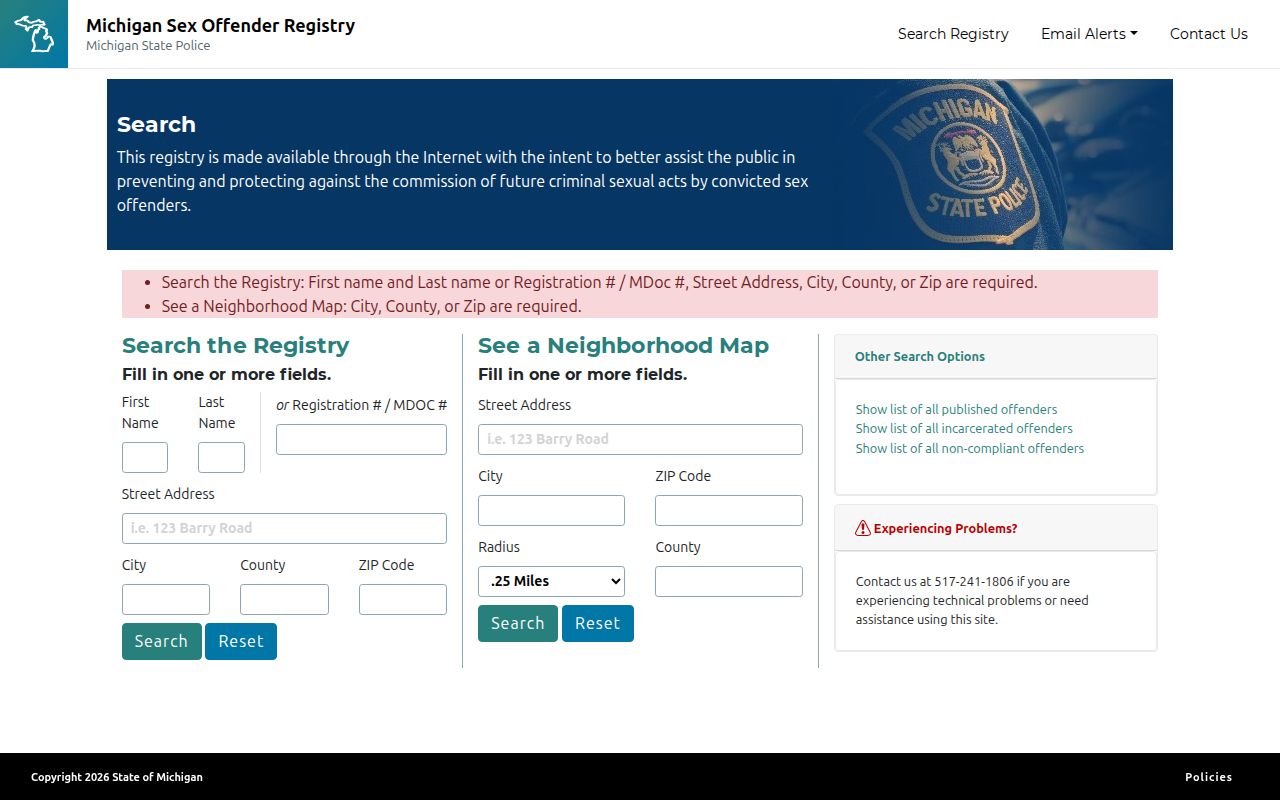
The official layout allows searching by name or registration number. Address geography works too, by city, county, ZIP, or radius. Victim information stays withheld, and there is no bulk download. Some entries are missing, expired, or removed. Others are juvenile or nonqualifying. Those entries should never be used to draw a conclusion about a person.
Garden City Resident Lookup Corrections
Every source has its own correction path. Assessment questions belong with the Garden City Assessor or Board of Review. Recording or indexing questions go to the Wayne County Register of Deeds. Voter data questions belong with the Garden City Clerk or the Bureau of Elections. A court error goes to the court of record. A vital-record amendment belongs with MDHHS. Have the parcel ID and document number ready. Add the case number, source date, and supporting proof for the custodian.
When no routine access route fits, a written request under the Michigan Freedom of Information Act is the next step. It must describe the record well enough to locate it. Agencies normally respond within five business days. A written ten-business-day extension is allowed. The response can grant, deny, partially grant, or request a deposit. Exemptions and redactions still apply. A FOIA response never promises that every field will be released.